Witness Confidence Exercise
In this exercise you will watch a short video of an incident, then take part in a short identification task and answer a few questions.
- Watch the video carefully.
- Complete a short filler task.
- View a lineup and select the person you believe you saw.
- Answer a couple of follow-up questions.
There are no trick questions. Just give your honest responses throughout.
Watch the incident
Watch carefully. After the video ends, a button will appear to continue.
Describe the perpetrator
Brief word task
Unscramble the words below while you wait. The task ends automatically after 2 minutes.
Anagram 1 of
Identification lineup
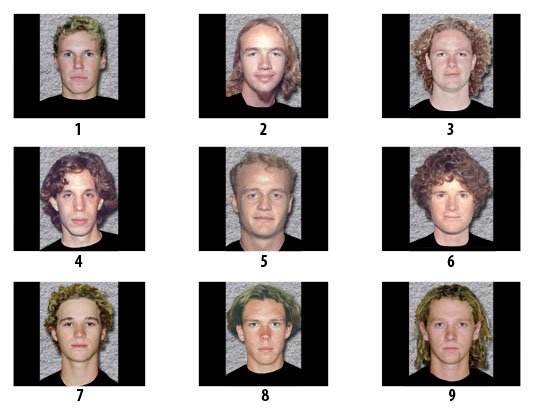
You will now see a lineup of nine people. You must select the person you believe is the perpetrator.
Look carefully at each person before deciding. Select the position number that best matches the person you saw.
Make your selection
Thank you
Describe the perpetrator again
From memory, describe the person you saw in the video as fully as you can. Do not look back at anything.
Your confidence now
What this exercise demonstrates
Your confidence:
Before feedback: / 10 — After feedback: / 10
How readers of this textbook responded
The post-identification feedback effect. The lineup used in this exercise was a target-absent parade: the actual perpetrator was not present. This means that whatever position you chose, the person you selected was innocent. Yet if you received confirming feedback (“Well done — you selected the perpetrator”), your confidence after that feedback was likely higher than it was immediately after making your choice.
This is the post-identification feedback effect, first demonstrated by @wells1998. Confirming feedback inflates not only confidence but retrospective reports of how good a view the witness had, how much attention they paid, how certain they felt at the moment of identification, and how easy they found the task. None of these inflated reports reflects any real difference in witnessing conditions.
The mechanism is not deliberate fabrication. Witnesses are reconstructing their past experience, and feedback provides information that appears relevant to that reconstruction. When the original memory is weak, the influence of external cues is strongest. This is precisely when identifications are least likely to be accurate. The result is that confidence expressed after investigative contact — months later at trial — can be substantially higher than confidence expressed at the moment of identification, without any genuine improvement in memory. This is why researchers and reform advocates treat the first immediate confidence statement as the only reliable evidential record of a witness’s certainty.